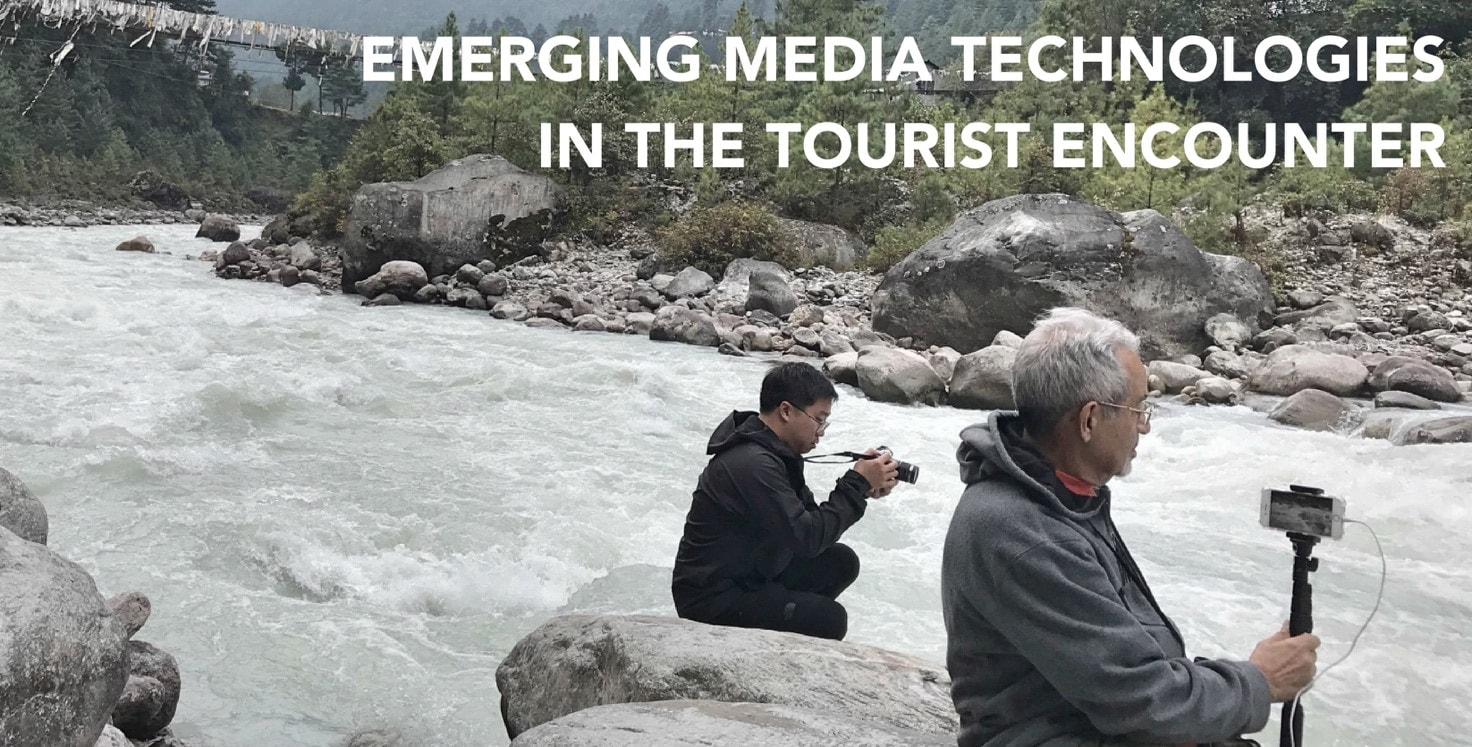
Emerging Media Technologies in the Tourist Encounter
Special Issue of Tourism Geographies
Edited by
Jolynna Sinanan
University of Manchester, England
Christian Ritter
Erasmus University Rotterdam, the Netherlands
Contact email: [email protected]
Jolynna Sinanan
University of Manchester, England
Christian Ritter
Erasmus University Rotterdam, the Netherlands
Contact email: [email protected]
|
Call for Papers
Expectations and experiences of tourism shape and are shaped by uses of digital technologies. The turn towards the digital and the imbrication of computer architectures of binary code into everyday life have had profound impacts on processes of spatial knowledge that have long held the interest of geographers (Ash, Kitchin and Leszcynski, 2018.) Facilitating the production and consumption of digital content, such as text, image, video, database and audio message, emerging media technologies (including social and digital media platforms, mobile media devices, geo/locative apps, augmented and virtual reality) are socio-technical assemblages which consist of forms of labour, arising techno-science, identities, infrastructures, earlier forms of devices and communities of practice. This special issue examines practices, meanings and impacts of emerging media technologies: digital, mobile, geo/locative and augmented reality technologies within tourism geographies. The special issue aims to situate emerging media technologies within processes of the production and transformation of space, spatial knowledge and social relations within the tourist encounter. We ask contributors to the special issue to consider: What are the configurations of different technologies involved with tourist experiences? In what ways do emerging media technologies shape tourism imaginaries and experiences? What are the particular cultural inflections in the relationship between digital and tourist practices? How do broader infrastructural and economic conditions shape the relationships between digital and tourist practices? A substantial body of work has considered the role of digital technologies in relation to tourist consumer practices and marketing strategies (Gretzel et al. 2016; Kah et al. 2011; Xiang and Gretzel, 2010). A further body of research has examined digital visual and social media practices and their relationship to performing tourism, placemaking and (self-) representation (Mostafanezhad and Norum, 2018; Polson, 2021; Smith, 2018). Additional scholars have explored the shifting challenges tour guides face due to the ubiquitous use of smartphones and on-site technologies inherent in contemporary tourist sites (Conti and Heldt Cassel 2020; Robertson et al. 2020; Weiler and Black 2015). More recently, an emerging area of focus has considered the implications of digital technologies for power relations within tourism processes and in particular, the role of digital technologies in deepening social and economic inequalities (Frenzel et al. 2022; Frenzel and Frisch 2020). Yet, the sociocultural transformations that unfold from emerging media technologies in the tourist encounter are multifaceted and multidirectional (Cade et al. 2019; Gibson 2012; Jeffrey et al. 2021). Investigating these conditions pose new methodological challenges in relation to the design of mobile fieldwork, the analysis of ephemeral media content and access to places of coding (Merriman 2014; Elliot et al. 2017). Social media platforms for example, are integrated into the everyday lives of individuals who work in tourist industries and play an instrumental role in managing relationships and aspirations beyond immediate work environments. This may be particularly significant in rural contexts where livelihood strategies require long distance travel and navigating family and social relationships at a distance. Councils and local government bodies may work with designers and app developers where uses of locative apps may have unforeseen and unintended consequences such as the re-attribution of value to specific sites. For instance, tourism apps can direct tourists to neglected cultural heritage sites and increase the visibility of festivals, revitalising revenue flows to local stakeholders. As tourism research is particularly suited for interdisciplinary scholarship, we especially invite researchers across social sciences and humanities including anthropology, geography, history, sociology, media and cultural studies to capture the unfolding state of emerging media technologies in shaping tourism processes. We emphasise the tourist encounter to move beyond the perceiving tourism as a host or guest endeavour and to take into account the mobile realities of tourism as a total phenomenon (Chio, 2011; Crouch, 2006). Papers in this special issue will explore the unfolding contexts of media, digital and emerging technologies in tourism geographies across breadth and depth and may include the following topics:
The guest editors welcome submissions on a wide variety of theoretical and/or empirical contributions to the study of emerging media technologies in tourism geographies beyond the suggestions identified. Authors are expected to clearly outline how they draw from and advance the field of tourism geographies in submitted abstracts. |
Submissions and publication timeline:
Approximately 8 papers will be sent out for full review. All other papers will be returned to their authors for submission elsewhere. The invitation to submit a full article does not guarantee acceptance into the special issue. Guest Editors
Dr Jolynna Sinanan is a Lecturer in Social Anthropology at the University of Manchester. She has an interdisciplinary background in anthropology and development studies and she has conducted comparative ethnographic studies of digital practices and infrastructures in relation to intergenerational mobilities in the Asia-Pacific, the Caribbean and South Asia. Her current areas of research are automated decision-making in countries in the Global South and mobile media and mobile livelihoods in the Everest tourism industry in Nepal. She is the author of Social Media in Trinidad (2017, UCL Press) and the co-author of Digital Media Practices in Households (2020, Amsterdam University Press), Visualising Facebook (2017, UCL Press) and How the World Changed Social Media (2016, UCL Press). Dr Christian Ritter is a Lecturer in Media and Communication at Erasmus University Rotterdam. He has a background in sociology, applied social studies and ethnology and his main research interests include cultures of influencers, digital labor, platformization and tourism media. His most recent research is funded by the Estonian Research Council (2018-2020) and assesses the emergence of travel influencers as a professional group in the global tourism industry. His work has been published in journals including Qualitative Research and Cultural Analysis and he has contributed to The Sage International Encyclopedia of Travel and Tourism (2017, Thousand Oaks). References
|
